How to choose marketing channels with the Bullseye framework
Use the Bullseye framework from the book Traction to pick marketing channels: brainstorm all 19, rank them, run cheap tests and focus on the one that works.
Start readingThe Bullseye framework, from the book Traction by Gabriel Weinberg and Justin Mares, helps you decide which marketing channels to work on. You write a test idea for each of the 19 traction channels, rank them, run cheap tests on the three most promising and then put most of your effort into the one that works.
It suits early teams with more channel ideas than time, and it stops you from picking channels only because you already know them. If you are still deciding whether marketing should lead your growth at all, start with our guide to marketing-led growth.
Where the Bullseye framework comes from
Traction was written by Gabriel Weinberg, the founder and CEO of DuckDuckGo, and Justin Mares. Penguin Random House lists the Portfolio edition with a publication date of October 6, 2015. The publisher describes it as a guide to nineteen channels for building a customer base, plus a three-step framework called Bullseye for choosing among them.
Before that edition came out, Mares described the method in a guest essay on Brian Balfour’s site in 2014, where he split it into five steps. That is why some summaries call Bullseye a three-step framework and others a five-step one. Both describe the same process. We summarize it in our own words; read the book for the founder interviews and a chapter on each channel.
What are the 19 traction channels?
The channel names below match widely read summaries of the book. The descriptions, test ideas and links are ours.
| Channel | What it means | A first test idea or guide |
|---|---|---|
| Viral marketing | Users bring in other users, often through invites | Dropbox’s referral program |
| Public relations (PR) | Coverage in news and trade press | Pitch one trade publication a story built on your own data |
| Unconventional PR | Stunts and giveaways that earn attention | Run one small stunt tied to a real customer problem |
| Search engine marketing (SEM) | Paid ads on search engines | Search ads and the search terms report |
| Social and display ads | Paid ads on social networks and websites | A creative testing plan for Meta ads |
| Offline ads | Print, radio, TV, billboards and direct mail | Sponsor one niche print newsletter your buyers read |
| Search engine optimization (SEO) | Earning unpaid search traffic | Programmatic SEO and our search section |
| Content marketing | Articles, guides and videos that draw buyers in | Our content section |
| Email marketing | Emails that turn signups into active customers | Email marketing for onboarding |
| Engineering as marketing | Free tools that attract buyers | Engineering as marketing at HubSpot |
| Targeting blogs | Getting mentioned on blogs your buyers read | Ask three niche blogs for a review or guest post |
| Business development | Partnerships that open up each other’s customers | Our partnerships section |
| Sales | People who find, contact and close buyers | Send 50 personal emails to best-fit buyers and count replies |
| Affiliate programs | Commission for partners who send customers | Offer a commission to five consultants who advise your buyers |
| Existing platforms | Growing on a platform that already has your users | Integration pages on a partner’s platform |
| Trade shows | Exhibiting at industry shows | Visit one show and book meetings before paying for a booth |
| Offline events | Hosting or sponsoring meetups and dinners | Host one dinner for ten best-fit buyers |
| Speaking engagements | Talks to rooms full of likely buyers | Pitch a talk to one regional association |
| Community building | A group of users who help each other and spread the word | Our community section |
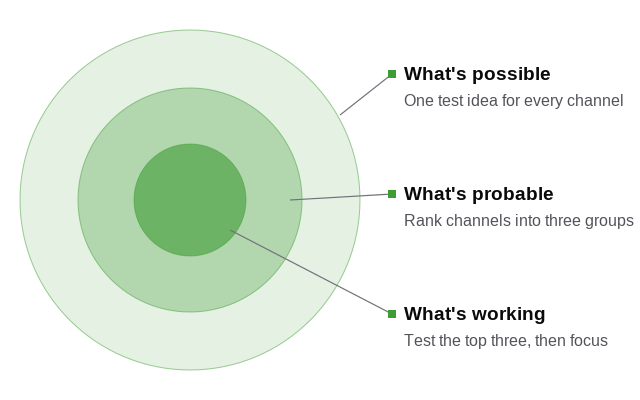
The three rings and five steps of Bullseye
Picture a target. You start at the edge with every channel and move inward as you learn.
Outer ring: what’s possible
Write one realistic test idea for every channel, including ones that seem wrong for your business. Make it specific: “sponsor the regional physio association newsletter” is a test, while “try offline ads” is a category.
Middle ring: what’s probable
Rank the channels into three groups: the few most promising, those that are possible, and long shots.
Inner ring: what’s working
Test the top three. The one that clearly works becomes your main channel.
The five steps
Mares’s essay counts the same process as five steps:
- Brainstorm one test idea per channel.
- Rank the channels into promising, possible and long shot.
- Prioritize the top three for testing.
- Test them with small, cheap experiments run side by side.
- Focus most of your effort on the channel that works.
How do you design a cheap channel test?
A channel test asks whether a channel can bring customers at a cost and volume you can live with. Set five things before you start:
- One test idea from your brainstorm.
- A budget or time box, such as $500 or 15 hours over three weeks.
- One metric. Pick the number closest to revenue that the test can produce in time, such as cost per demo request.
- A pass mark. Write down the result that counts as a pass, for example “under $150 per demo request”. Decided afterwards, almost any result looks promising.
- A record of spend, hours, result and decision in one shared sheet.
When a channel has several possible tests, rank them with ICE scoring. And because talks, podcasts and word of mouth often leave no click trail, ask new signups how they heard about you during every test.
Bullseye worked example: a scheduling tool for physio clinics
Take a hypothetical company, Pivotly, that sells scheduling software to independent physiotherapy clinics. Every number below is made up.
Goal. Pivotly has eight paying clinics, all from the founders’ contacts. It wants 40 within six months.
Outer ring. The founders spend an afternoon writing one idea per channel, such as a free month for each referred clinic and a free calculator that shows what missed appointments cost a clinic each year.
Middle ring. They rank the ideas. Promising: search ads on a handful of high-intent terms, a talk at a regional meetup for clinic owners, and the missed-appointment calculator. Possible: email, community and partnerships with practice consultants. Long shots: offline ads, trade shows and unconventional PR.
Inner ring. They run three tests over four weeks.
| Test | Budget and time | Pass mark | Result | Verdict |
|---|---|---|---|---|
| Search ads on eight high-intent terms | $600 | Under $150 per demo request | 2 demo requests at $300 each | Fail |
| 20-minute talk at a clinic owners’ meetup | $150 travel, 10 hours | At least 5 demo requests | 7 demo requests, 3 trials | Pass |
| Missed-appointment calculator | 25 hours to build | At least 10 demo requests | 140 uses, 18 emails, 1 demo request | Inconclusive |
The search ads failed because so few clinic owners search for this software that each click was expensive. The talk passed easily, since the room was full of exact buyers. The calculator is inconclusive: it depends on search traffic, and four weeks is too short to judge that, though 18 email signups suggest interest.
Focus. Pivotly makes speaking engagements its main channel. One founder books a talk each month with regional clinic owner groups and follows up by email. The calculator stays live for a six-month check. Search ads are paused.
When to run it again. Pivotly will repeat the exercise when talks stop bringing in demo requests at the same pace, or in six months. By then a long shot such as partnerships with practice consultants may move up.
How to choose marketing channels if you skip the framework
Without the full exercise, three habits get you most of the way. Start from your positioning: who you serve and where those buyers already look for help. Favor channels where your buyers already gather, such as a search they already type, an association they belong to or a platform they already use. Then test before you commit, with a pass mark set in advance. What the Bullseye adds is an idea for every channel you would otherwise ignore.
Where the Bullseye framework falls short
- Slow channels fail short tests. SEO, content and community can take months to pay off. Give them a longer time box, or judge them on early signals such as rankings or email signups.
- Small tests can mislead. With a few dozen clicks, one odd week can swing the result. Treat a near miss as inconclusive and rerun it.
- Focus can starve the next channel. Keep one small test running beside your main channel so you have something ready when it stalls.
- The answer changes over time. Channels get crowded and costs rise, so rerun the exercise every six months or when growth slows.
- A weak brainstorm gives a weak ranking. A lazy idea makes a channel look worse than it is, so ask someone who knows the channel to check it.
For more on running and reading tests, browse our analytics and experiments section.
Questions and answers
Common questions
How many marketing channels should a startup focus on at once?
Most early teams do best with one main channel that gets most of their marketing time, plus one or two small tests running beside it. Spreading effort evenly across many channels makes it hard to do any of them well enough to see a result.
How long should you test a marketing channel before you decide?
Fast channels such as search ads, social ads and direct sales outreach can give a first answer in two to four weeks. Slow channels such as SEO, content and community usually need several months, so judge them early on leading signals like rankings, replies or email signups.
What is the difference between the Bullseye framework and ICE scoring?
The Bullseye framework helps you choose which marketing channel to work on. ICE scoring ranks individual experiment ideas by Impact, Confidence and Ease, so it is most useful once you have picked a channel and need to decide which tests to run inside it.